ChatGPT Ads for Real Estate Agents (September 2026)

A new way to reach buyers mid-thought
For twenty years, home buyers typed a few words into a search bar (something like "homes for sale in Calgary") and scrolled through blue links. That's not how it works anymore.
Buyers and sellers now turn to ChatGPT long before they ever look for an agent. Instead of one quick search, they run a whole conversation: school catchment boundaries, property tax trends, neighbourhood safety, commute times, renovation costs, dozens of questions across dozens of prompts.
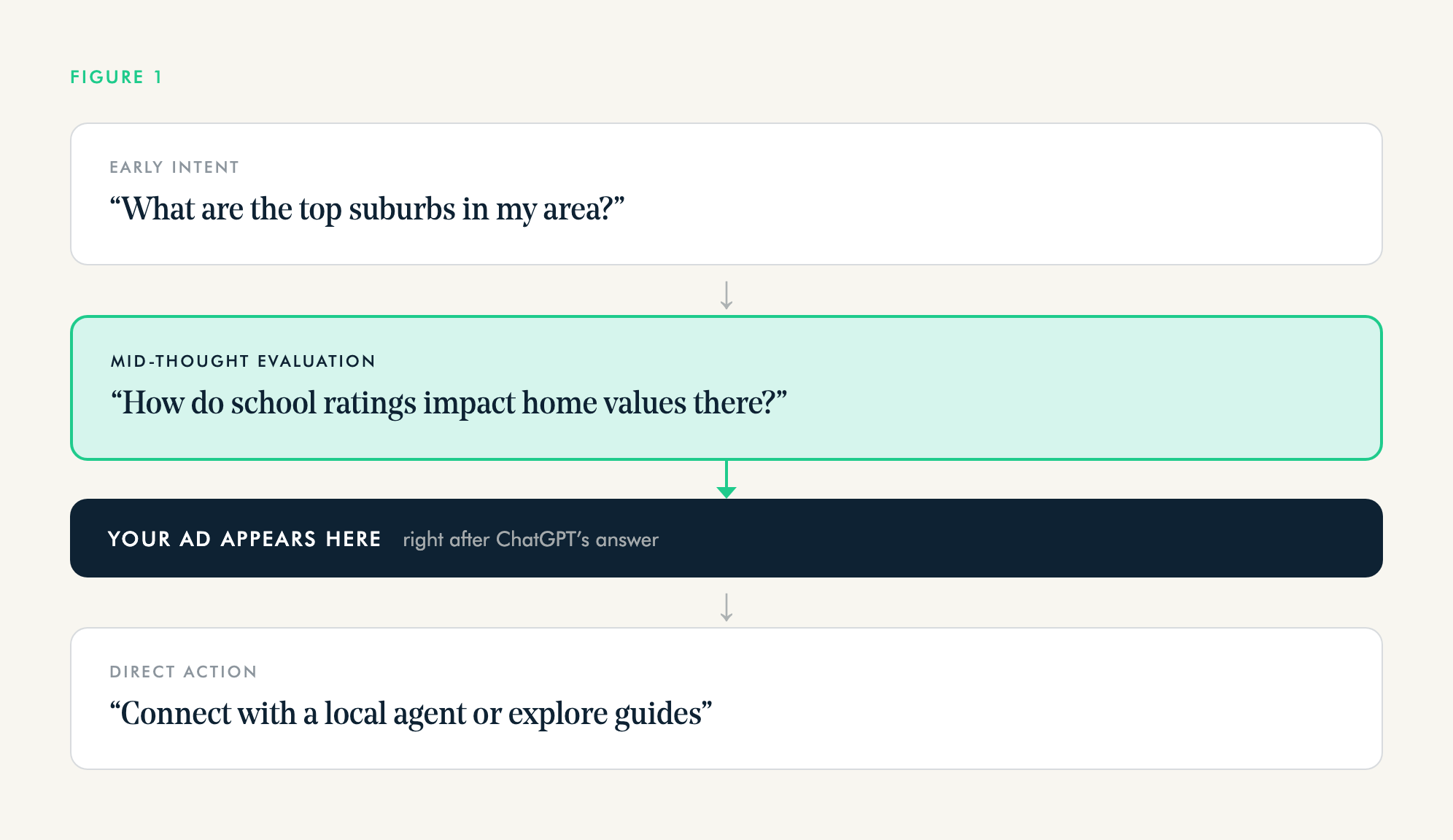
That's where you can reach them, while they're still deciding where to live and not only what to buy. The discovery arc runs in three stages:
- Early intent: "What are the top suburbs in my area?"
- Mid-thought evaluation: "How do school ratings affect home values there?"
- Direct action: "Connect with a local agent or explore guides."
Your ad shows up right after that second stage, once ChatGPT has already given its answer.
The post-answer advantage
Social feeds interrupt a scroll and search engines put ads above the answer, but on ChatGPT your ad shows up after the answer, labelled as sponsored and set apart from the response itself.
By the time your ad shows up, the reader already has their answer in hand, which makes your ad the next step in the same train of thought.
Who actually sees these ads
OpenAI only shows ads to logged-in adults on the Free and Go plans. Anyone on ChatGPT Plus, Pro, Business, or Enterprise never sees one.
The ad-supported crowd skews toward entry-level buyers, renters, first-time sellers, and people planning a local move, which is the group a residential agent wants and the group running an active search right now.
The upkeep
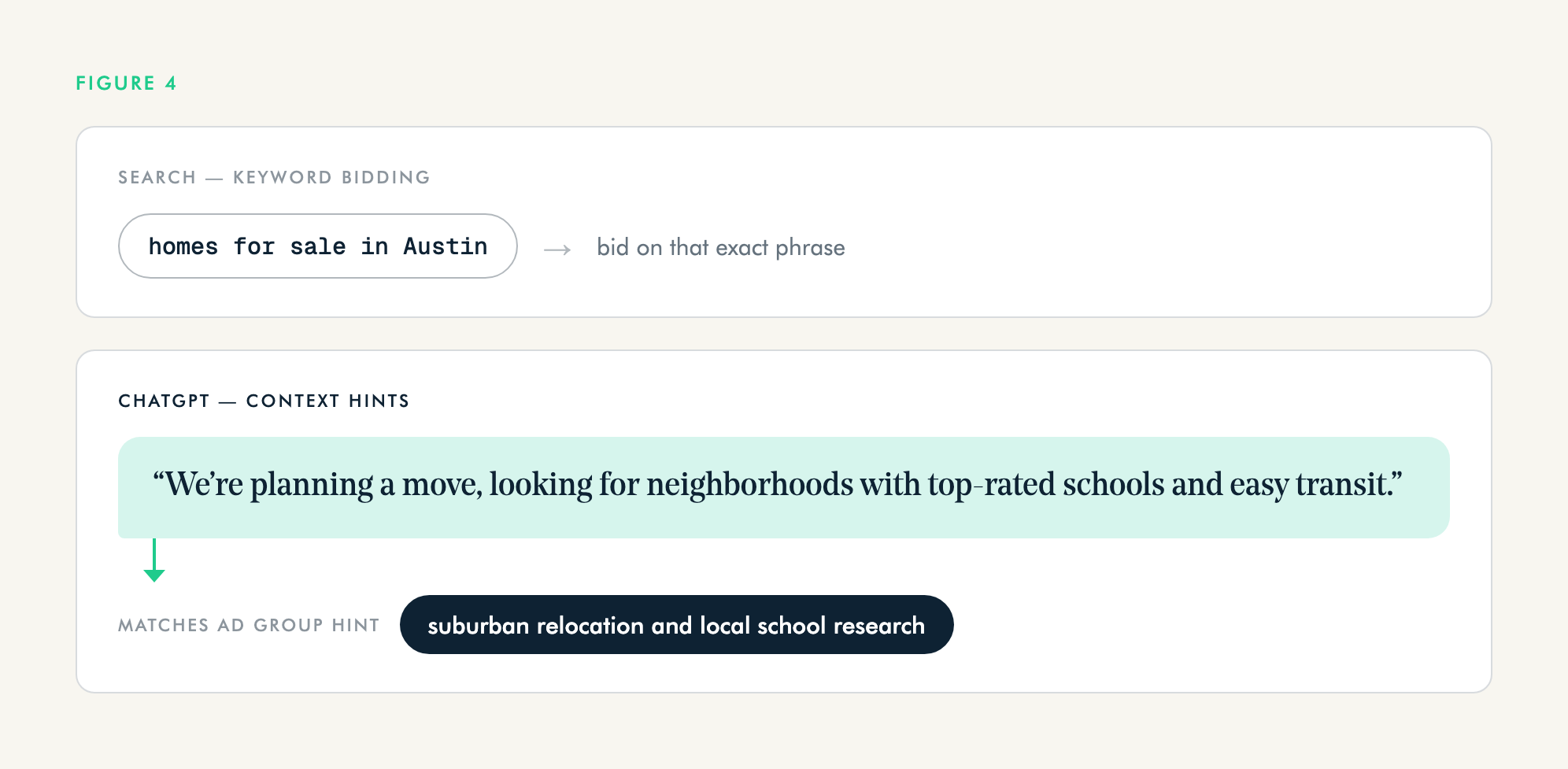
ChatGPT ads do not run on keyword bids or demographic lists. Placement depends on "context hints," plain-language descriptions that map your message to whatever is being discussed.
Keeping those hints current, testing your messaging, and watching how topics shift takes ongoing attention every month the campaign runs.
Platform mechanics, budget rules, and policy boundaries
The baseline ad format
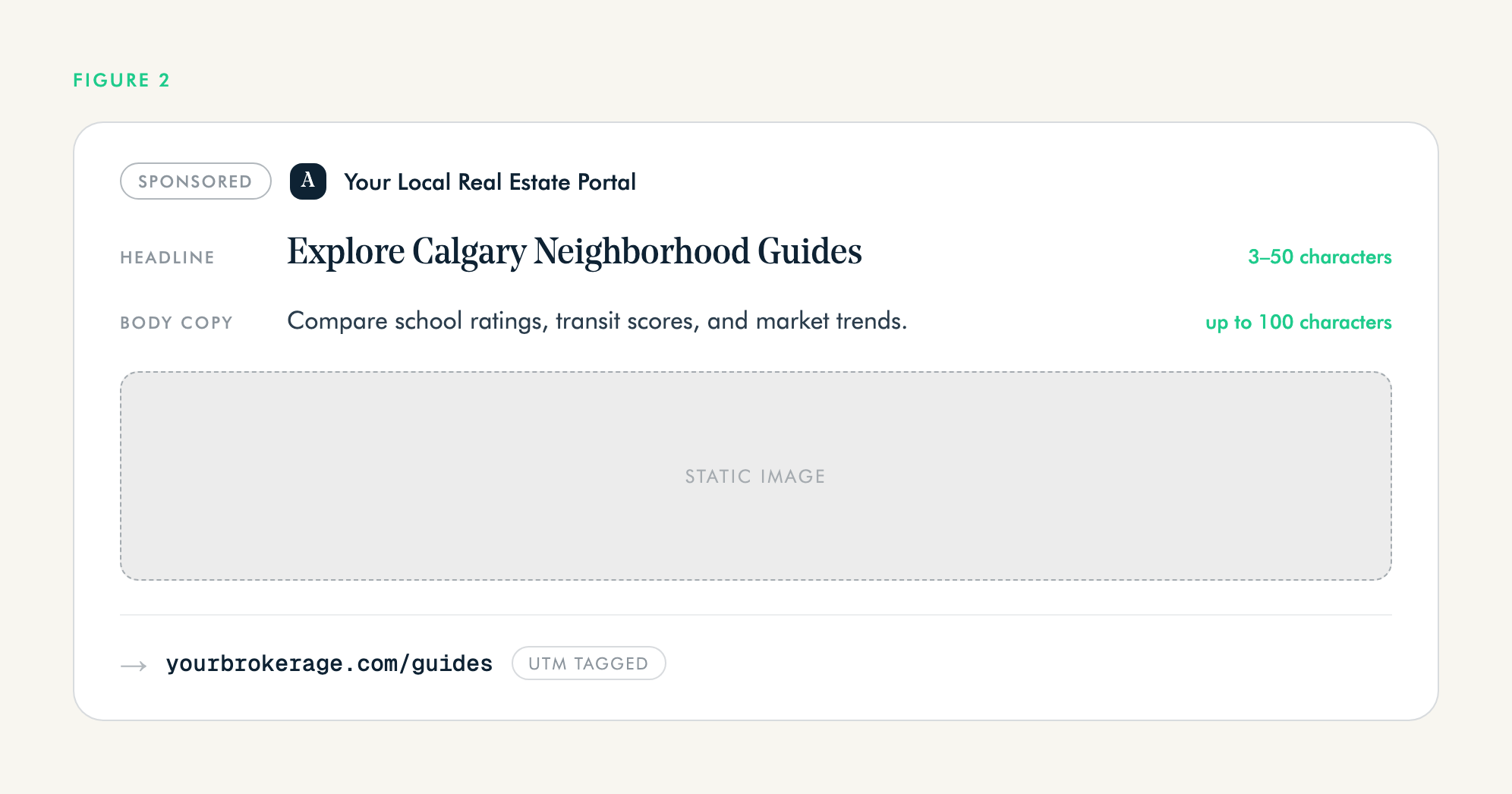
Every ad on ChatGPT uses the same native format, the chat_card. Your assets need to hit these specs:
- Headline: 3-50 characters, clear and specific
- Body copy: up to 100 characters, one practical benefit, not a slogan
- Image: one clean, static visual, no clutter or text overlays
- Favicon: a 128x128 brand icon next to your name
- Destination URL: a live link with campaign tracking tags
A finished card reads like this:
Budget mechanics
OpenAI's self-serve Ads Manager has no minimum to open an account or run a trial, which is a change from the six-figure enterprise deals the platform used to require.
Once your campaign goes live, OpenAI requires a $25 daily minimum per ad group, and that spend is what enters your ad into the relevance auction.
The no-individual-listing policy
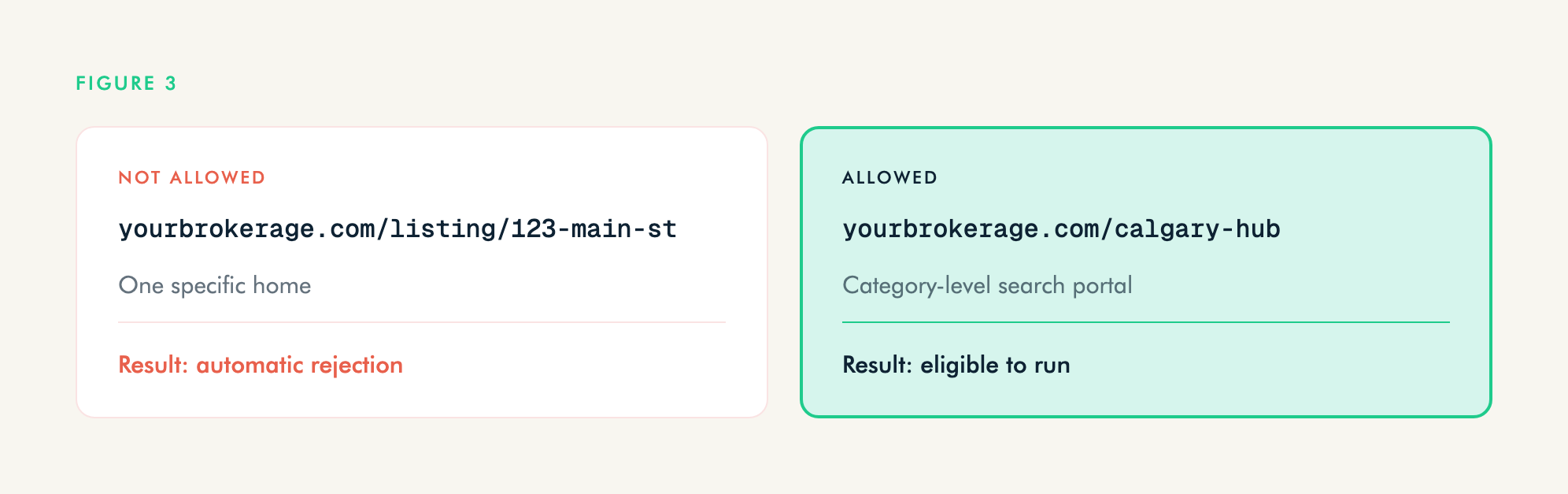
OpenAI will not allow ads for individual listings, specific addresses, or MLS® IDs, and it is the rule that catches real estate advertisers first. Try to run "3-bed beauty at 123 Main Street," or link straight to one listing page, and the campaign gets rejected automatically.
OpenAI's policy does carve out an exception. You can link to a site with job or house listings, as long as neither the ad nor the landing page names a specific listing.
- Rejected: one specific home, address, or listing page
- Allowed: neighbourhood search portals, home valuation tools, market trend reports, buying guides
The financing blanket rule
OpenAI allows a handful of US financial-services ads under manual review, but mortgage and lending ads are banned everywhere else, including here in Canada.
Keep mortgage and lending claims out of your ad copy and your landing pages entirely, because a rate promise or a mortgage calculator on the page risks suspending the whole account rather than the one ad.
Where the ad sends people
Selling the portal, not the listing
Because individual listings are off the table, your landing page has to work differently than it does on search or social, where linking straight to one listing is routine. On ChatGPT that same link is an instant rejection.
Send traffic to a category resource instead:
- Neighbourhood search hubs: portals covering home trends, school ratings, and community profiles across a city or suburb
- Home valuation tools: instant estimates or a sales report for sellers
- Buying and relocation guides: planning resources for someone moving into your area
The dynamic deep-link trap
Watch your link structure as closely as your ad copy. Plenty of real estate sites use dynamic parameters or auto-redirects that quietly route a broad search, something like "Search Calgary homes," straight to one property page based on whatever filters someone applied.
OpenAI's filters catch that too, so check every destination link before launch and confirm it lands on a category page no matter which filters a visitor arrives with.
Domain and crawler readiness
Before your ad can go live, OpenAI's crawlers, OAI-AdsBot and OAI-SearchBot, need to reach your landing page and confirm it matches your ad. If your firewall, your security plugin, or your content security policy blocks those crawlers, the ad gets stuck in review or fails outright.
Check that your domain allows crawler access, and have a verified 128x128 favicon ready before you launch your first ad group.
Conversational intent and what to write
Context hints vs. traditional keywords
Instead of bidding on a phrase like "MLS listings Calgary," you write plain-language descriptions of a topic or situation at the ad group level. ChatGPT's delivery engine reads the whole conversation, the questions asked, the themes running through them, and how your landing page fits, then decides when your ad belongs.
A conversation like "We're planning a move, looking for neighbourhoods with top-rated schools and easy transit" might match an ad group hinted toward "suburban relocation and local school research."
Why search-ad copy falls flat here
"#1 Agent in Town! Call Today!" reads as an interruption in the middle of an advice thread, because that's exactly what it is.
Write instead like you're extending the reader's own research:
- Lead with what the resource does for the reader rather than who you are
- Name the thing they would open: a market report, a valuation tool, a neighbourhood guide
- Match the post-answer moment, where the reader already has their answer and is deciding what to do with it
Speaking to three stages at once
Effective campaigns cover three intent layers:
- Awareness: early movers asking broad questions about city dynamics, tax rates, relocation logistics
- Consideration: people weighing specific neighbourhoods, school catchments, or pricing trends
- Decision: people ready to use a valuation tool or reach out to a local resource
Writing distinct copy for each stage, then testing it against conversations that never repeat the same way twice, is the ongoing work of running this channel.
Tracking, results, and where this sits
What reliable tracking requires
Measuring results here means connecting what a visitor does in their browser with confirmation of a lead on your server, which takes a few moving pieces:
- Server-to-server reporting: lead events route directly from your server to OpenAI, so ad blockers and strict mobile privacy settings can't hide them
- Deduplication: a matching key stops your account from counting the same lead twice when both the browser and the server report it
- Encrypted contact data: emails and phone numbers get hashed before they're sent, so raw contact info never leaves your systems
- Consent checks: tracking only turns on once a visitor has given privacy consent, keeping you compliant with regional privacy rules
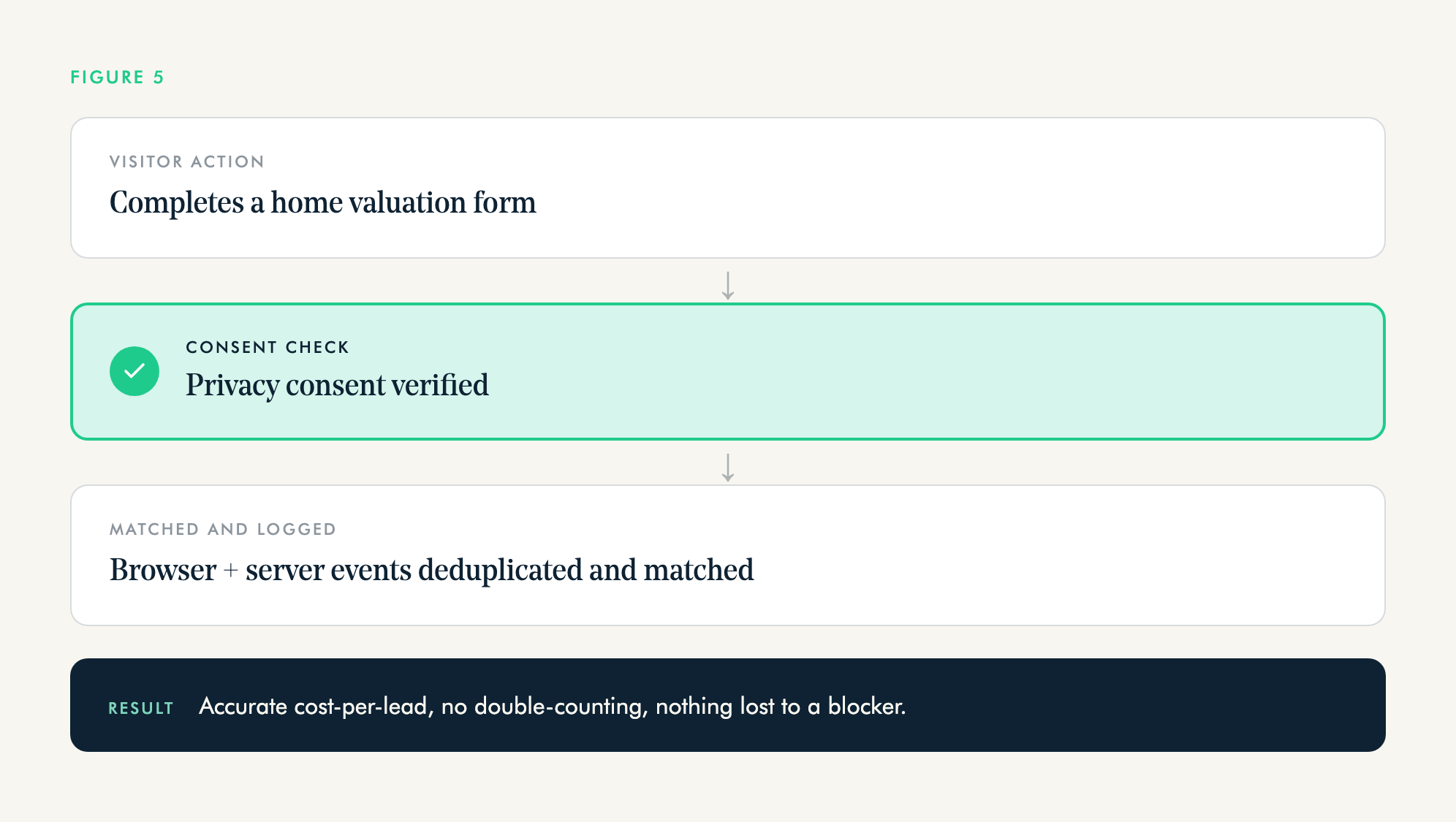
A visitor fills out a valuation form, consent gets checked, and the lead is logged on both ends and matched, which is how the cost per lead comes out accurate without double-counting and without losing anyone to a blocked script.
Evaluating results
Judge performance against that post-answer position. The reader arrives at your page having already got their answer elsewhere on the screen.
Someone who clicks through arrives at your search portal or valuation tool mid-thought, already deep in their own research. There is no published benchmark for the format yet, so treat your first month of spend as the baseline you measure against.
This channel sits earlier than the others. Search still catches people ready to act right now and social builds recognition, while ChatGPT ads reach people while they are still researching, before either of those channels sees them.
What running this takes
Auditing every destination link so nothing deep-links to a listing, writing separate copy for three intent stages, and keeping consent checks and deduplication working while the campaign runs. None of that is complicated on its own, and all of it is standing work that sits on top of the website, the local search presence, the social channels, and the client follow-up already in the day.
A campaign like this only pays off if the page the ad lands on is worth landing on. A neighbourhood hub with live listings, current market numbers, and a valuation tool is the thing doing the work here, and the ad is traffic pointed at it.
That is why we offer ChatGPT ads as part of the new Concierge package. Our team builds the site with live MLS listings, runs the local search and content work that gets those pages found on Google and ChatGPT, and keeps the lead capture and follow-up wired up behind them.
To work out whether Concierge fits what you are running now, talk to our team.
See what Avenue can do for your business.
Start with a free website, or talk with our team about the right setup for your business.
