8 Things Every Agent's Website Needs to Win Clients
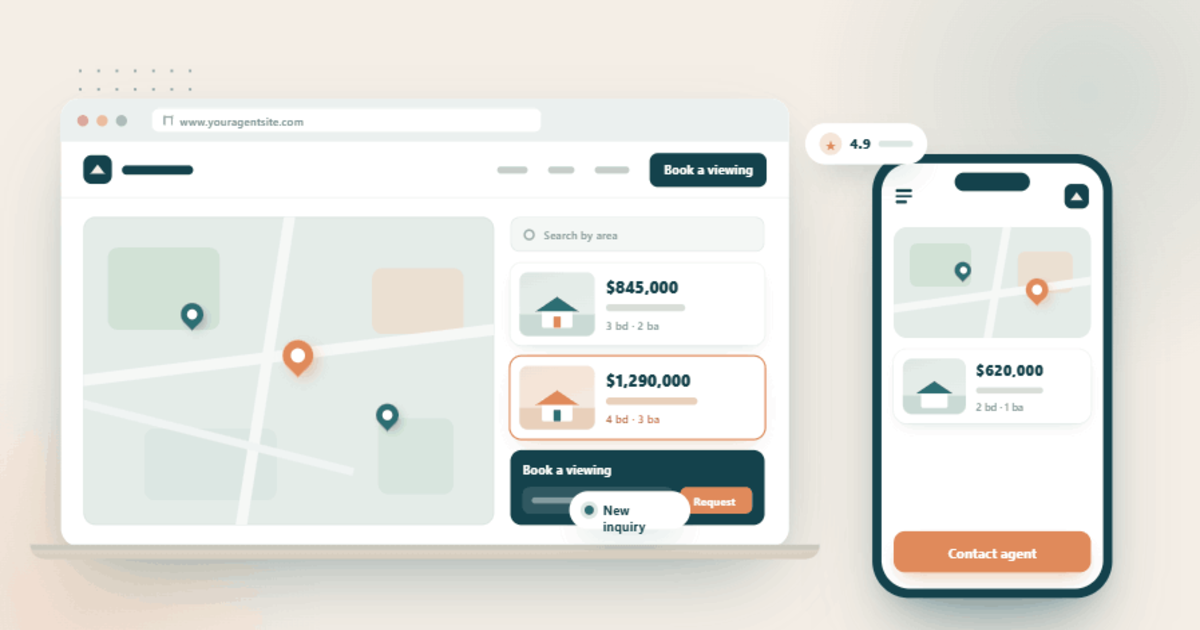
A strong real estate agent website does more than look professional. It helps buyers search homes, captures leads, builds trust, and gives you a clear way to follow up.
Many agent websites fall short. They look fine, but they do not turn visitors into leads. (More on why real estate websites fail to generate leads.) The best agent websites tend to share the same core features, and there are eight of them. This checklist covers what separates a useful agent website from one that simply exists online.
The 8-point checklist
A real estate website that brings in business should include:
- IDX property search
- Clear, visible contact options on every page
- Lead capture forms connected to a CRM
- Fast, mobile-friendly design
- A clear agent bio, strong photos, and client reviews
- Local neighborhood and market content
- A clear call to action
- Your own domain, data, and brand
Start with the job your website needs to do
Before colors, layout, or design style, define the job of the site. For most agents, that job is simple: help the people already searching for homes become leads you can follow up with. A good-looking site that does not capture inquiries is not doing enough. Each of the eight features below supports that goal.
1. IDX property search and live MLS listings
If buyers cannot search homes on your site, they will search somewhere else. Most buyers begin their home search online, something the National Association of REALTORS® has reported for years, so your website needs to be a place where that search can happen. IDX (Internet Data Exchange) lets you show live MLS listings on your own website, so buyers search on your site and contact you directly. (Here is a fuller explainer on what IDX is.)
Good IDX search should be easy to use. Look for map search, saved searches, listing alerts, and filters that make sense on a phone. Depending on how the platform is built, IDX can also add listing and local market pages, though search visibility varies by implementation.
2. Clear contact options on every page
Visitors should never have to hunt for your phone number or contact form. Put clear contact options on every page, and offer more than one way to reach you, since not everyone is ready for the same step. Useful options include “Ask about this listing,” “Book a consultation,” “Request a home valuation,” and “Get new listings by email.”
3. Lead capture connected to a CRM
Capturing a lead is only half the job. The other half is following up. A form that is not connected to anything is a lead you may never see. Route every inquiry into a CRM so it lands in one place where you can track new leads and respond quickly. Fast follow-up matters because the same buyer is often contacting more than one agent.
4. Fast, mobile-friendly design
Most visitors will see your website on a phone. If the site loads slowly, hides key information, or makes property search hard to use, people leave before they ever contact you. Mobile-friendly design is not an upgrade. It is the baseline.
5. A bio, photos, and reviews that build trust
People often choose an agent before they choose a house. Your website should help them understand why they should trust you. That means a bio that sounds like a real person, strong photos, reviews from past clients, and video if you have it. The goal is not to write a résumé. It is to help a potential client feel confident reaching out.
6. Local content that helps people find you
Listings help people find you when they search for a specific property. Local content helps you reach people who do not know your name yet. Think neighborhood guides, market updates, and buyer and seller explainers, like “Best neighborhoods for first-time buyers in Raleigh,” “What $900k buys in your market,” or “Moving to a new neighborhood: a buyer’s guide.” It takes longer to pay off than ads, but it builds SEO for real estate listings that compounds over time.
7. A clear call to action
Every page should make the next step obvious. Tell visitors exactly what to do, for example “Search homes,” “Book a showing,” “Get a home valuation,” or “Save this search.” A site without a clear call to action leaves people guessing, and visitors who have to guess rarely convert.
8. Your own domain, data, and brand
Large listing portals can sell you leads, and they can sell similar leads to other agents in your market. Your own website is different. It gives you a place to build your brand, capture your own leads, and keep control of your audience. That makes it worth building on something you own.
How to get the website you need
There are three common ways to put this together, plus where Avenue fits.
| Option | Best for | Watch out for |
|---|---|---|
| DIY website builder | Lowest cost | IDX and CRM often cost extra or are missing |
| Custom designer | A polished, custom brand | Slower launch and higher cost |
| Real estate website platform | Fastest complete setup | Features vary by plan |
| Avenue | Agents who want a free starting point with IDX, lead capture, and CRM included | Optional managed marketing costs extra |
Whichever route you choose, ask one question early: is IDX included, or billed separately? That detail is where many low monthly prices start to climb.
The bottom line
A real estate agent website works when it covers these eight fundamentals well. People can search homes, contact you easily, trust what they see, and land in a system where you can follow up. Get the eight right and your website becomes part of how you generate business, not something you set up once and forget.
Start with a free real estate website
You do not have to stitch together a website builder, IDX plugin, lead forms, and a CRM. Avenue brings them into one place: the free plan includes a real estate website, IDX property search, lead capture, CRM tools, and mobile-ready design. See plans and start for free.

See what Avenue can do for your business.
Start with a free website, or talk with our team about the right setup for your business.
