How Real Estate Agents Can Get Leads Without Buying Them
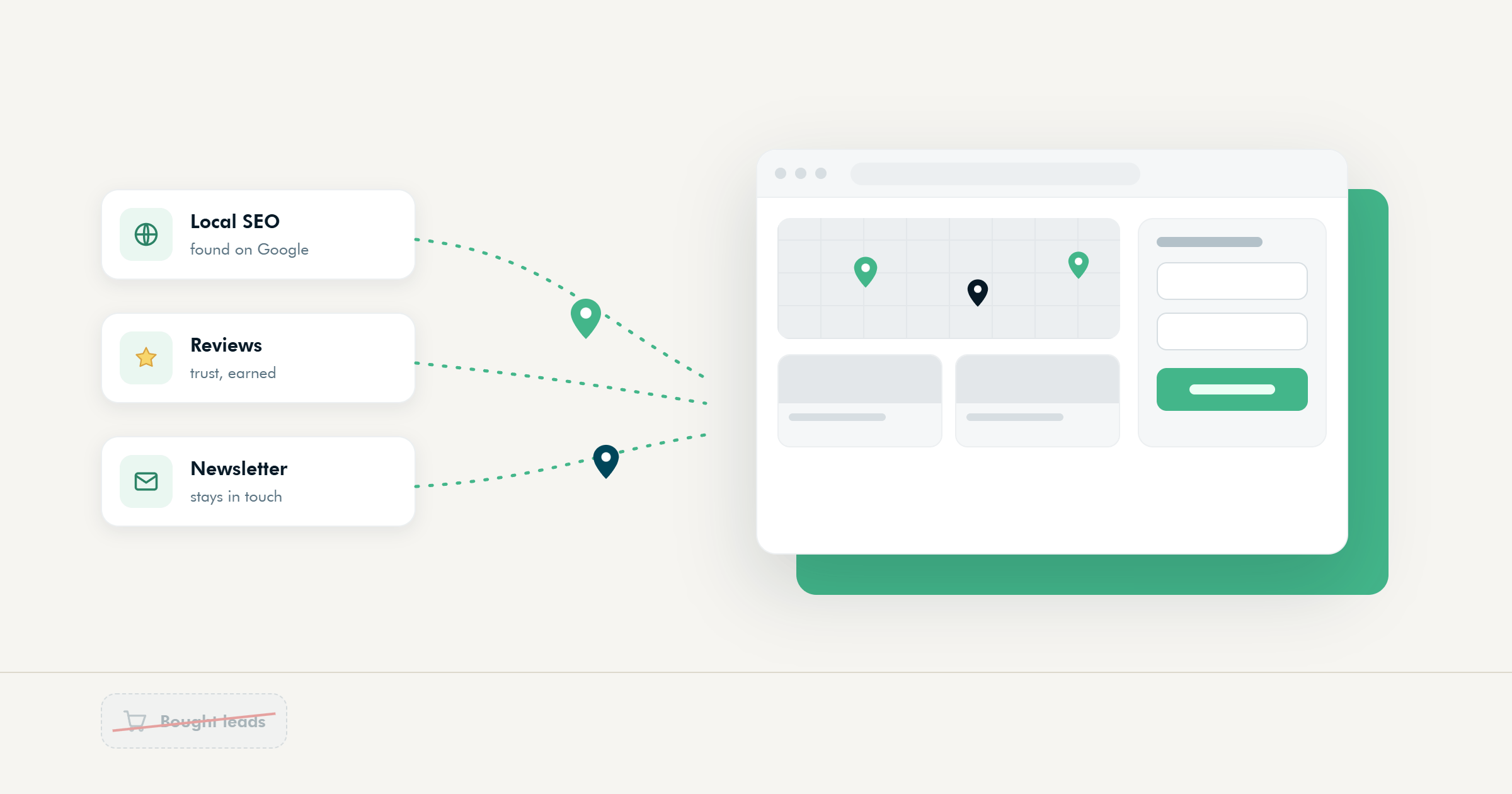
Organic growth for real estate agents means building the things that help people find, trust, contact, and remember you, without relying entirely on paid leads. The core pieces are simple: a website you own, local SEO, reviews, useful neighborhood content, lead capture, CRM follow-up, and consistent nurture. What matters most is that they are connected, so every lead moves through all of them.
This is not an argument against paid. Paid leads and paid ads work for plenty of agents. The problem is when paid is the whole plan. You end up competing to respond first against other agents who bought the same lead, and the moment you stop paying, the pipeline stops too.
The real question is whether you have something of your own, built around who you serve, where you work, and why clients trust you. And whether you can see which parts of it produce actual conversations. Paid works best when it points at that. It can't stand in for it.
Copying everyone else's tactics makes you interchangeable
Most lead generation advice for agents is the same list: post on social, blog “5 tips for home buyers,” buy a zip code. None of it is wrong. All of it is generic, and generic is the problem. If your website says what every other agent's website says, a prospect comparing three agents has nothing to choose on.
Start from focus instead. The agent who can write “the best condo buildings in Yaletown under $700k” or “relocating to Calgary with school-age kids: which neighborhoods to shortlist” has something the other two open tabs don't. Whatever your version is, downsizers in one suburb, first-time buyers in one school district, a condo market you know floor by floor, your website should make it obvious in seconds: who you work with, where, and what you know that others don't.
Narrowing feels like shrinking your market. In practice it gives referrals a reason to stick, makes your relevance easier for Google to understand, and gives prospects a reason to pick you instead of flipping a coin.
Word of mouth still needs proof online
Ask agents where business comes from and most say referrals and repeat clients. True. It is also exactly why what people find when they search you matters more than “word of mouth is free” suggests.
Here is what a referral actually looks like now. A friend mentions your name at dinner. Before calling, the prospect searches you. They look for your website, and if you don't have a real one, that search ends somewhere else. They skim your reviews, check whether you have actually sold in their neighborhood, and read your bio to decide if you are someone they would trust with the biggest transaction of their life.
If they find a stale profile, three reviews from 2019, and no trace of the expertise your friend vouched for, the referral leaks. The prospect quietly adds a second agent to the list, and now you are competing for a lead that was supposed to be yours. Keeping your website, reviews, and Google profile current is part of protecting your referral business.
What each channel builds, and what it doesn't
| Growth source | What it does well | What it doesn't build |
|---|---|---|
| Portal leads | Fast access to active buyers/sellers | Owned audience or exclusivity |
| Paid ads | Immediate traffic and fast testing | Traffic after the spend stops |
| Social media | Visibility and staying top of mind | Reliable intent |
| Organic search | Discovery that can build over time | Instant volume |
| Website + CRM | An owned lead system | Results without setup, maintenance, and follow-up |
None of these are bad. But the first three stop producing the moment you stop feeding them. The last two keep working, as long as you keep them up. The rest of this article is about how they work together.
The owned growth system
Think of it as five stages in how a stranger, or a referred prospect, becomes a client: found, trusted, captured, followed up, remembered.
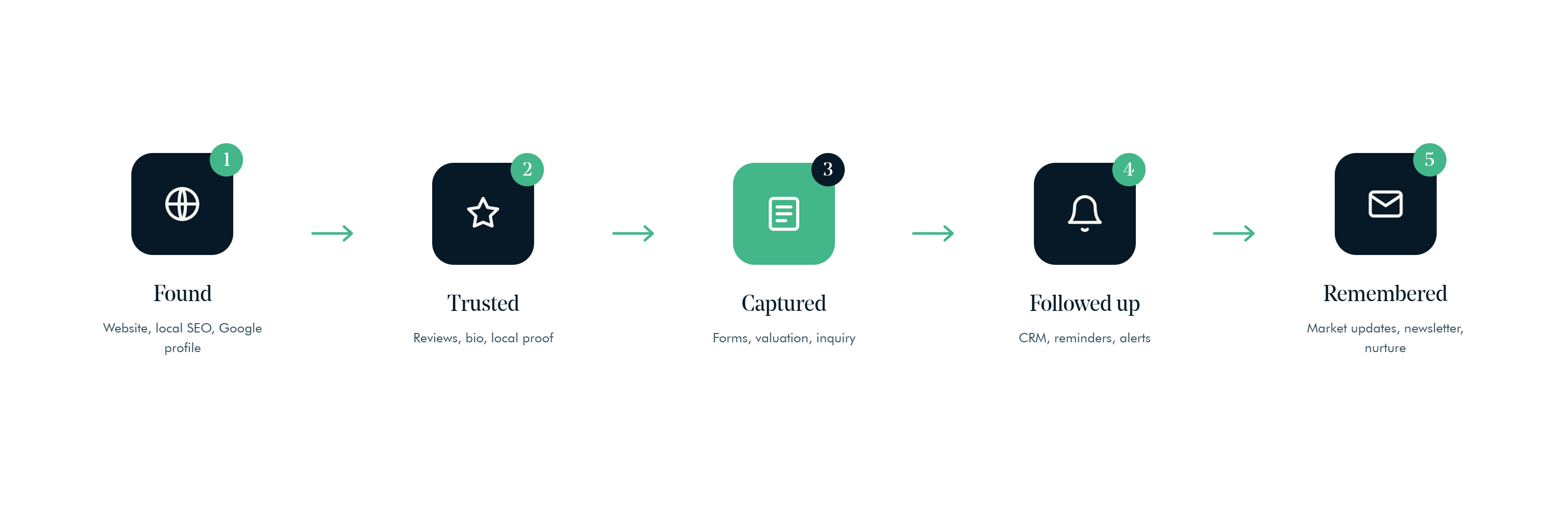
Found. Your website, your Google Business Profile, and pages that answer real local searches: “what $900k buys in East Vancouver,” “should I sell before I buy in Victoria,” a page for each neighborhood you actually work. IDX search can help here, but as a supporting piece.
Trusted. Recent reviews with responses. A bio that says something specific instead of “passionate about real estate.” Sales in the area. Content only someone who knows the market could write.
Captured. An obvious next step: a home valuation request for sellers, a listing inquiry path for buyers, forms that work, a phone number that is easy to find. A lot of “my website doesn't generate leads” is really “my website gives visitors nothing to do.”
Followed up. This is where most organic leads die. A seller requests a valuation, the email lands in your inbox during a showing, and by the time you reply they have booked with someone else. That lead should have entered a CRM: instant acknowledgment, a prompt to book the valuation appointment, then a monthly market update on their street until they are ready. Website leads need more than an inbox.
Remembered. Most people who find you are not transacting this quarter. Market updates, a newsletter worth opening, listing alerts. These keep you in the picture until the timing turns, and they keep past clients warm for the next referral.
None of this is exotic. The point is connection. A great website with no follow-up leaks. Great follow-up on a site nobody finds starves. Reviews nobody reads while researching you are wasted proof.
Where paid fits
Paid does two things well. It buys attention faster than organic earns it, and it teaches you fast: which message pulls, which neighborhoods respond, which offer converts.
What it can't do is substitute for the rest. Send paid traffic to a site with no focus, no proof, and no follow-up, and you have paid for bounces. Buy leads with no CRM behind them, and you are paying for names you will lose to whoever follows up better. Get the owned pieces working first, even at a modest level. Then paid multiplies what already converts, instead of becoming a monthly bill you can't stop.
Measure conversations, not traffic
“Working” doesn't mean traffic. It means conversations with real potential clients. The useful questions are concrete:
- Which pages do people visit before contacting you?
- Which searches bring visitors who inquire, and which bring visitors who bounce?
- When someone books a call, where did they start? Your neighborhood page, your Google profile, a referral searching your name?
- Which follow-up sequence turned a cold valuation request into a listing appointment five months later?
This doesn't require becoming an analyst. It requires the pieces to be connected well enough to trace a lead back to its source, and then one habit: do more of what produces conversations in your market, and drop the generic activity that doesn't.
What your website has to do now
“Look professional” used to be the bar. A site with a headshot, a brokerage logo, and a contact page clears the old bar and does nothing else. A working agent website now has four jobs:
- Answer local questions. The specific ones your future clients type, about your neighborhoods and price points.
- Prove you are the right choice. Current reviews, a specific bio, local track record, all easy to find.
- Capture the lead. Clear next steps for buyers and sellers, not a contact link in the footer.
- Feed follow-up. Every lead lands somewhere that acts on it, not an inbox that waits.
If your site does the first job and none of the others, it's a brochure.
Where IDX fits, and where it doesn't
IDX, the MLS listing search on your website, deserves a short and honest treatment. Where it helps: visitor experience. Buyers want to browse, and saved searches plus listing alerts give them a reason to return and give you a natural way to capture buyer leads. Where it's oversold: rankings. IDX pages are the same listing data on thousands of agent sites. Don't expect them to be why Google sends you traffic, and be skeptical of anyone selling IDX as an SEO strategy. Use it where it serves visitors. Don't mistake it for the strategy.
AI search raises the bar, but the work is the same
More people now ask AI assistants what they used to type into Google, including “who's a good agent in Kitsilano?” The practical answer is less exotic than the hype. AI systems tend to rely on the same things search engines and people rely on: clear, useful, trustworthy, well-organized information. Making it obvious who you are, where you work, what you specialize in, what clients say, and which local questions you can answer works for all three audiences.
Two cautions. Nobody can promise AI citations, and anyone selling guaranteed AI visibility is selling something they don't control. And tricks aimed at gaming AI answers are unlikely to last, for the same reason SEO tricks stopped working. The fundamentals don't change. The bar for clear, complete information just gets higher.
A 30-day starting plan
Organic growth is slow at first. That is the honest trade. A realistic first month:
| Week | Focus | Do this |
|---|---|---|
| 1 | Foundation | Rewrite your homepage and bio to name who you serve and where Submit your own contact form and see what happens Claim or update your Google Business Profile, where applicable |
| 2 | Local search | Build one page for your strongest niche (say, downsizing in North Vancouver) Answer the 3 to 5 questions those clients actually ask, in your own words |
| 3 | Proof + capture | Ask your last 5 happy clients for reviews, and respond to existing ones Put a valuation request and a buyer inquiry path where visitors can't miss them |
| 4 | Follow-up + measurement | Route website leads into a CRM with reminders, not your inbox Set up enough tracking to answer: when someone contacts me, where did they come from? |
Thirty days will not transform your pipeline, and anyone promising that is usually selling paid leads with extra steps. What it does is put the pieces in place, so each month builds on the last instead of starting over.
Where Avenue fits
Everything above is doable on your own, and some agents do exactly that. The hard part is not any single piece. It is that the pieces have to work together, and most agents did not get into real estate to run a marketing stack.
Avenue helps real estate agents turn their online presence into an owned growth system: a website, search visibility, lead capture, follow-up, and measurement working together.
Start with a free real estate website built to support organic growth.
Want help turning your website, reviews, local content, and follow-up into one connected setup? Talk to Avenue.
See what Avenue can do for your business.
Start with a free website, or talk with our team about the right setup for your business.
